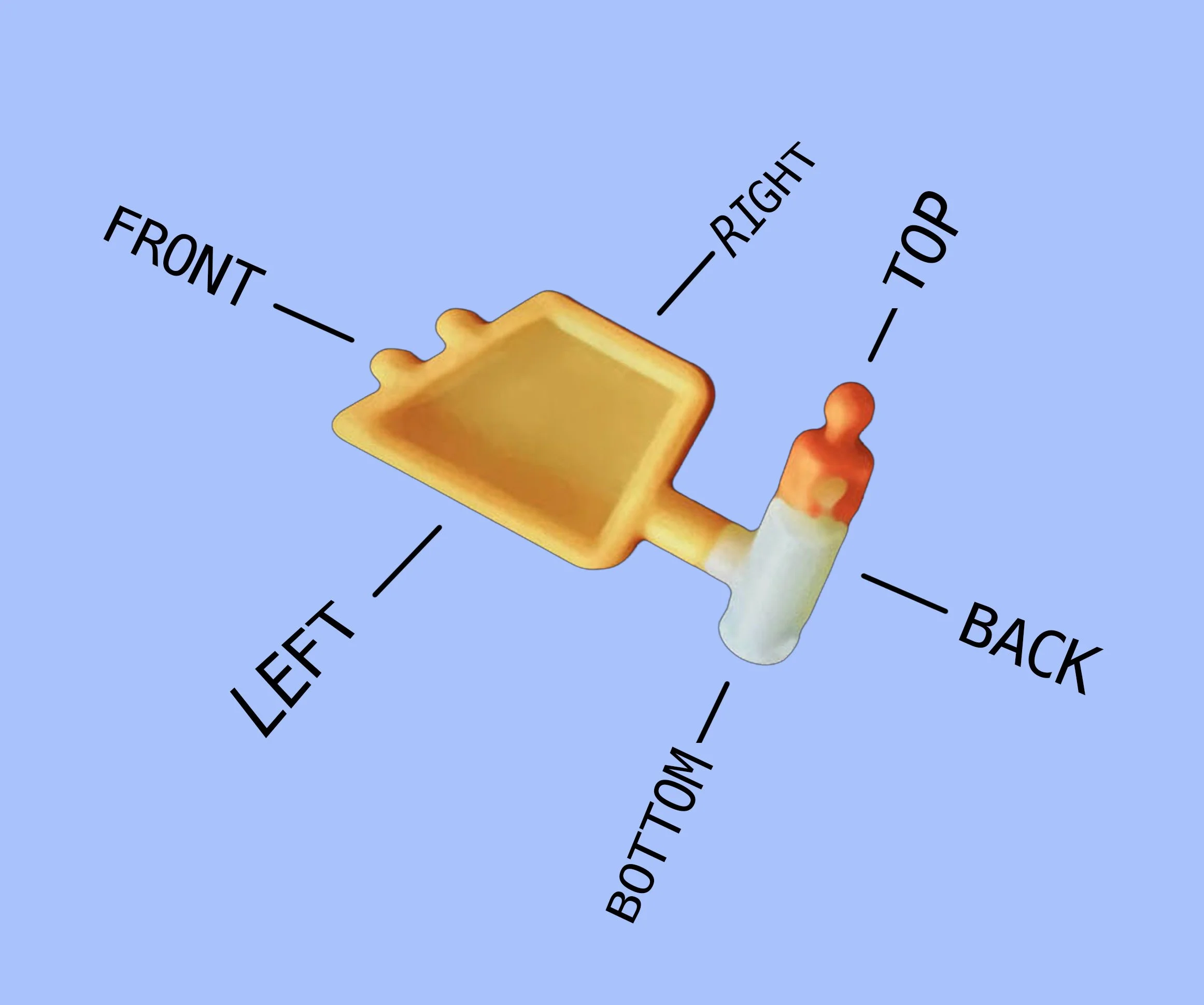
1. The 5’ phosphate is the ‘top’ and the sugar’s 3’ hydroxyl group is the ‘bottom.’
2. The base-pairing edge of the base is the ‘front,’ and the part of the sugar that (in a double helix) faces the outside world is the ‘back.’
3. Looking down from above (at the phosphate at the ‘top,’) you can see that the base obviously has ‘right’ and ‘left’ sides. The two sides are quite different from each other. The PlayDNA! cartoon base has a long side and a short side - which is which depends on the type of base. In real DNA, the right and left sides are also quite different from each other, and this is extremely important.
How is it important?
Well, when you have a double helix, the series of exposed edges (RIGHT edges, or LEFT edges) of the base-pairs form a definite pattern (determined by the sequence of course). Wherever a pattern exists, it can act as a ‘signal’ that is recognized by another pattern. And whenever a signal exists in a reproducible way, some other reproducible pattern inevitably comes along that can and does recognize it, and puts it to some use. I’m thinking about sequence-specific DNA-binding proteins. These are the things that make our DNA useful! Everybody should know about them!
One very sexy class of sequence-specific DNA-binding proteins is the big family of STEROID HORMONE RECEPTORS. These proteins (when activated by an appropriate steroid hormone) will latch onto a specific DNA sequence that exists at the front end of many genes. The latching-on of the protein triggers gene transcription. A very big deal!
Did you know that Vitamin D is not a vitamin, but a hormone? Indeed, it is a steroid hormone. Not a ‘sex steroid’ like you’re thinking - its target genes have nothing to do with reproductive behavior in particular. What genes does the Vitamin D Receptor activate? Thousands of genes, different sets of genes in different cell types, involved in all kinds of essential physiological processes. Bone growth is only one of many! - maybe just the first to noticeably fail if Vitamin D is insufficient.
Click HERE for a beautiful animation of Vitamin D activating its receptor, which then latches onto a DNA sequence and triggers transcription. Animation by Drew Berry.
Steroid hormone receptors are just one of many families of TRANSCRIPTION FACTORS, sequence-specific DNA-binding proteins that trigger (or suppress) the start of transcription of some specific gene or genes (typically tens or hundreds or thousands of specific ‘target’ genes). An animal’s genome encodes OVER A THOUSAND different transcription factors. Don’t worry, you don’t have to memorize them all.