Obliquity and Opposition in Architecture: Both difficult, and more so together.
The PlayDNA! molecular modeling kit allows you to build a double helix in two different ways: the right way, and the wrong way. Without guidance, almost everybody does it the wrong way. And has a hard time imagining how any other way is possible!
Even Uncle Chris, regarded as a master of three-dimensional design and construction, needed help:
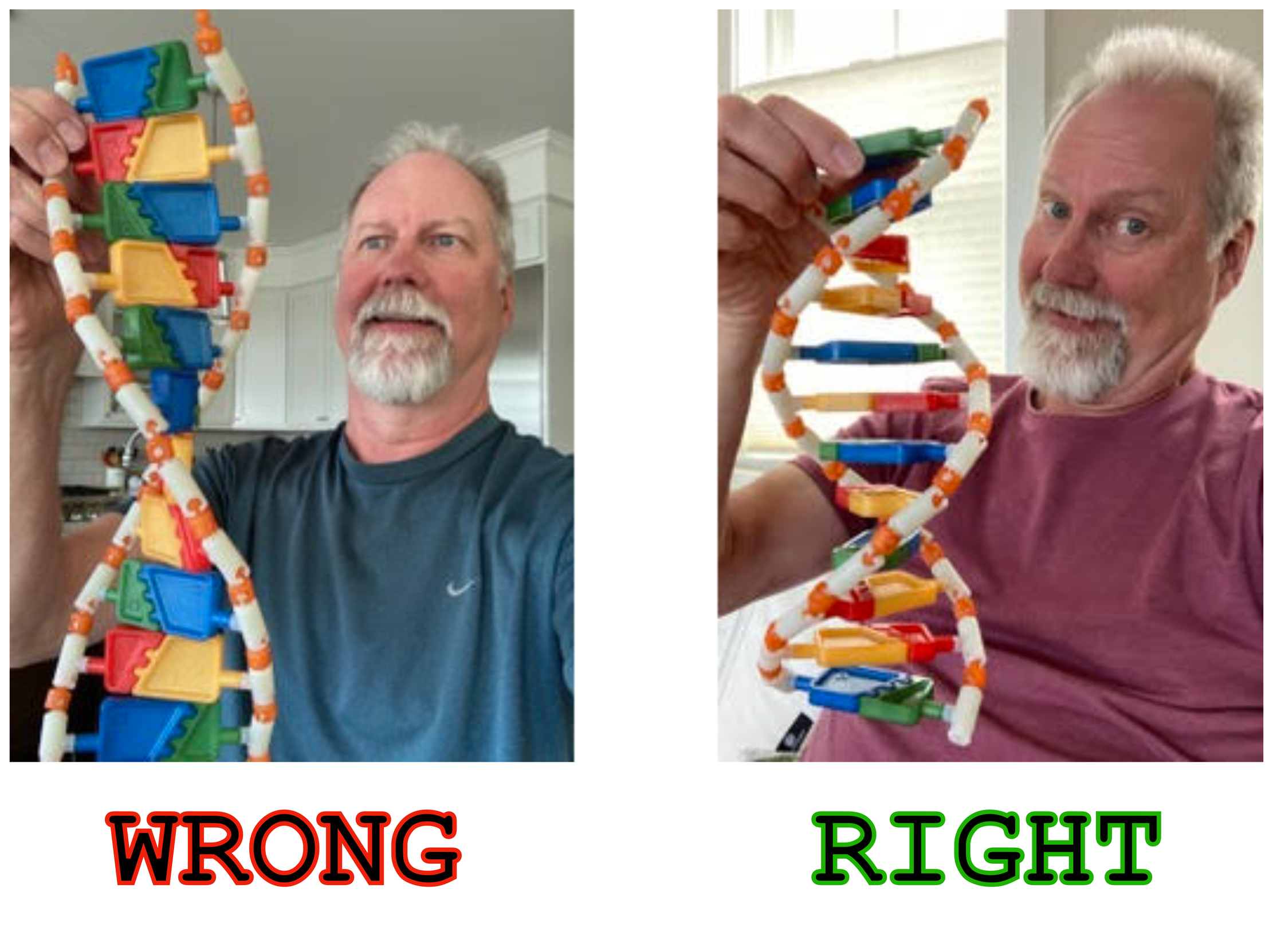
The right way produces a structure with roughly the shape of typical (“B-form”) double-stranded DNA: a right-handed double helix, with antiparallel (oppositely oriented) strands, and with base-pairs stacked like steps in a spiral staircase. (A mouse could walk up or down the vertically suspended model, stepping on the bases.) The overall structure has roughly the same helical slope as real DNA, with about 10 nucleotide pairs per revolution. This structure, like real DNA, is (within limits) quite flexible, capable of over- and under-winding as well as bending to a certain degree.
The wrong way produces a structure that resembles nothing in the real world of nucleic acids: a left-handed double helix with the two strands oriented in the same direction. The overall shape of the structure is like a propeller blade rather than a staircase, because the planes of base-pairs lie side-by-side, nearly parallel to the central axis of the helix; the edges of neighboring base-pairs are thus kissing each other, rather than being properly exposed to the outside world. The helical slope (or pitch) is much steeper (again more like a propeller blade): about twice as steep, 20 base-pairs per turn. Maybe because of this (or because of the kissing base-pair edges?), the whole structure is hardly flexible at all. It’s just so wrong.
Why is it so easy to build wrong, and so hard to build right? (I admit I got it wrong myself at first, and like most first-timers was stumped!) I guess it’s the synergy of two unfamiliar things: OBLIQUITY and OPPOSITION in three-dimensional space. Too much obliquity seems to break our brains, and who can blame us? most of the geometric solids that we industrialized humans normally deal with possess only (to some approximation) 90° and 0° angles. “The Twist” was an unconventional dance; the curves in my uncle’s handmade boat are curvaceous in only one plane. Structures with more degrees of freedom tend to be seen as wreckage, or as raw material yet to be ordered. But the seeming craziness of a tree’s roots and branches is not at all random: quite to the contrary, their tanglesome trajectories are the collective creation of precise three-dimensional wayfinding more sophisticated, I suppose, than our everyday individual conscious navigation. The bewildering 3D textile of a protein structure is perfectly formed to perform a task that leads to its own propagation. Its performance is understandable, but its formation is not: it’s just too complex. (The self-propagation is quite beyond our grasp.) And opposition? I guess maybe too we’re trained to be sure that a parallel pair of things, if they both have the same kind of directionality, must point in the same direction. I don’t know…
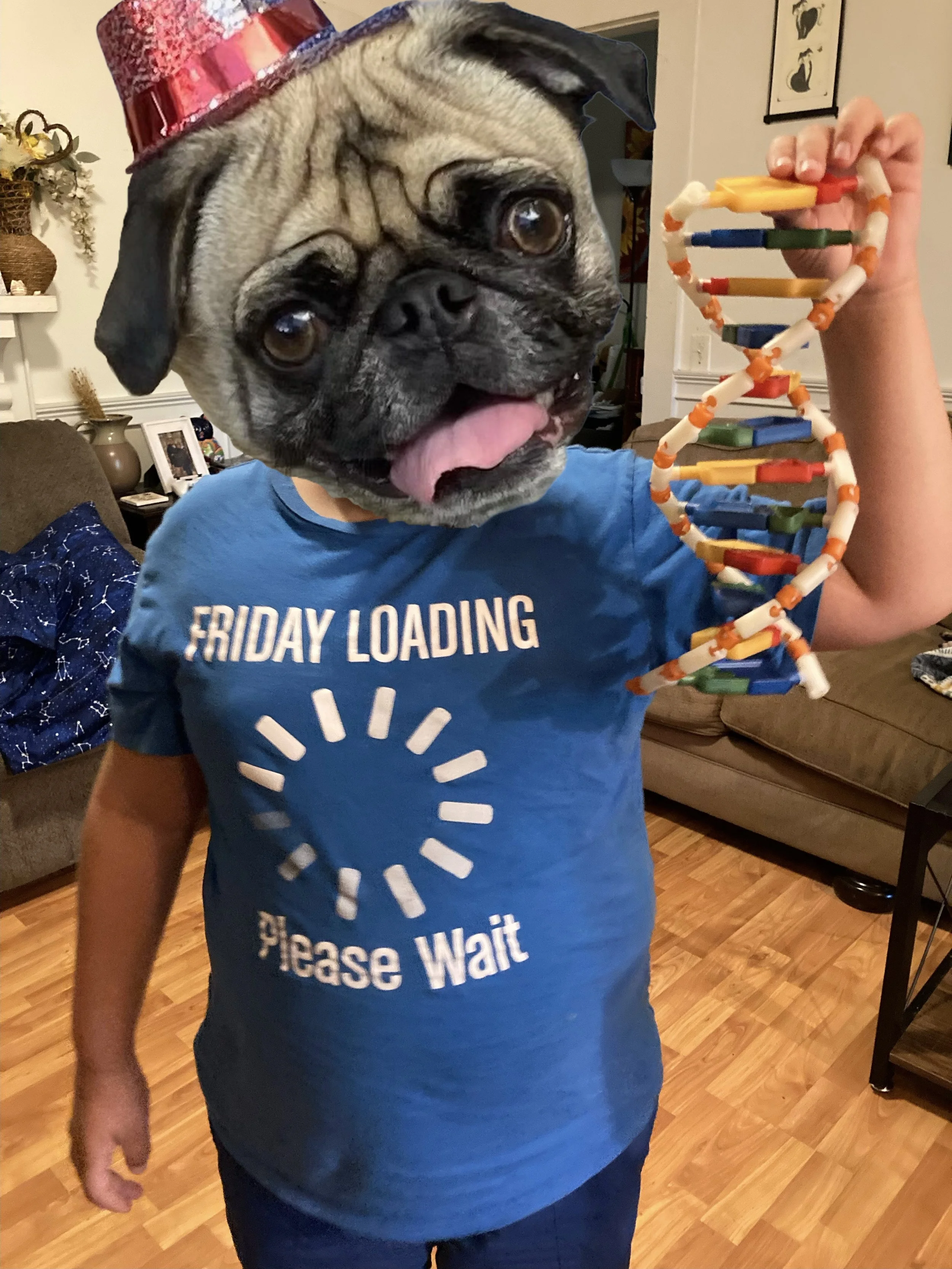
This exceptional youngster built right on the first try! Patriotic Pug Face protecting identity.
Coming soon, more facts and felicity about helicity - one of Life’s most favorite shapes.
More too about structural polarity, and also electrical polarity, and why both kinds of asymmetry are fundamentally essential for life’s existence.
GLOSSARY
A “spiral staircase” isn’t a spiral, it’s a helix. Ditto for the binding of “spiral bound” books. A spiral is a two-dimensional curve that winds outward from (or inward toward) a central point, like the groove on a vinyl phonograph disc. The path of a helix turns round and round in the two-dimensional plane while also piercing that plane to traverse the third dimension, like the groove in a wax Edison cylinder.
The path of a right-handed helix turns clockwise as it goes away from the viewer. The threads of screws, nuts and bolts, bottles and caps, jars and lids are almost always so - that’s why “righty tighty, lefty loosey.” (Righty means the way a clock’s hand travels past the 12 hour mark.)
A regular helix has a fixed girth (diameter), like a cylinder has. It also has a fixed pitch: the length (parallel to the central axis) over which the helix makes one complete turn. B-form DNA has a diameter of ~2.0 nm, and a pitch of ~3.4 nm.
The ratio of helical pitch to diameter is the helical slope. PlayDNA! and real DNA have roughly the same helical slope.